
Multirobot Control System for Automated Part Painting
This completed 2026 KBTU graduation project, developed by a four-person student team, is a distributed multirobot control system with real-time monitoring for an automated industrial painting line. It coordinates two collaborative painting manipulators, an industrial pick-and-place robot, and a conveyor within one production cycle. The laboratory implementation was modeled on an automotive painting line at Hyundai Trans Kazakhstan and designed for future industrial scale-up.
Research based on this project was accepted for The 20th IEEE International Conference on Control & Automation (IEEE ICCA 2026).
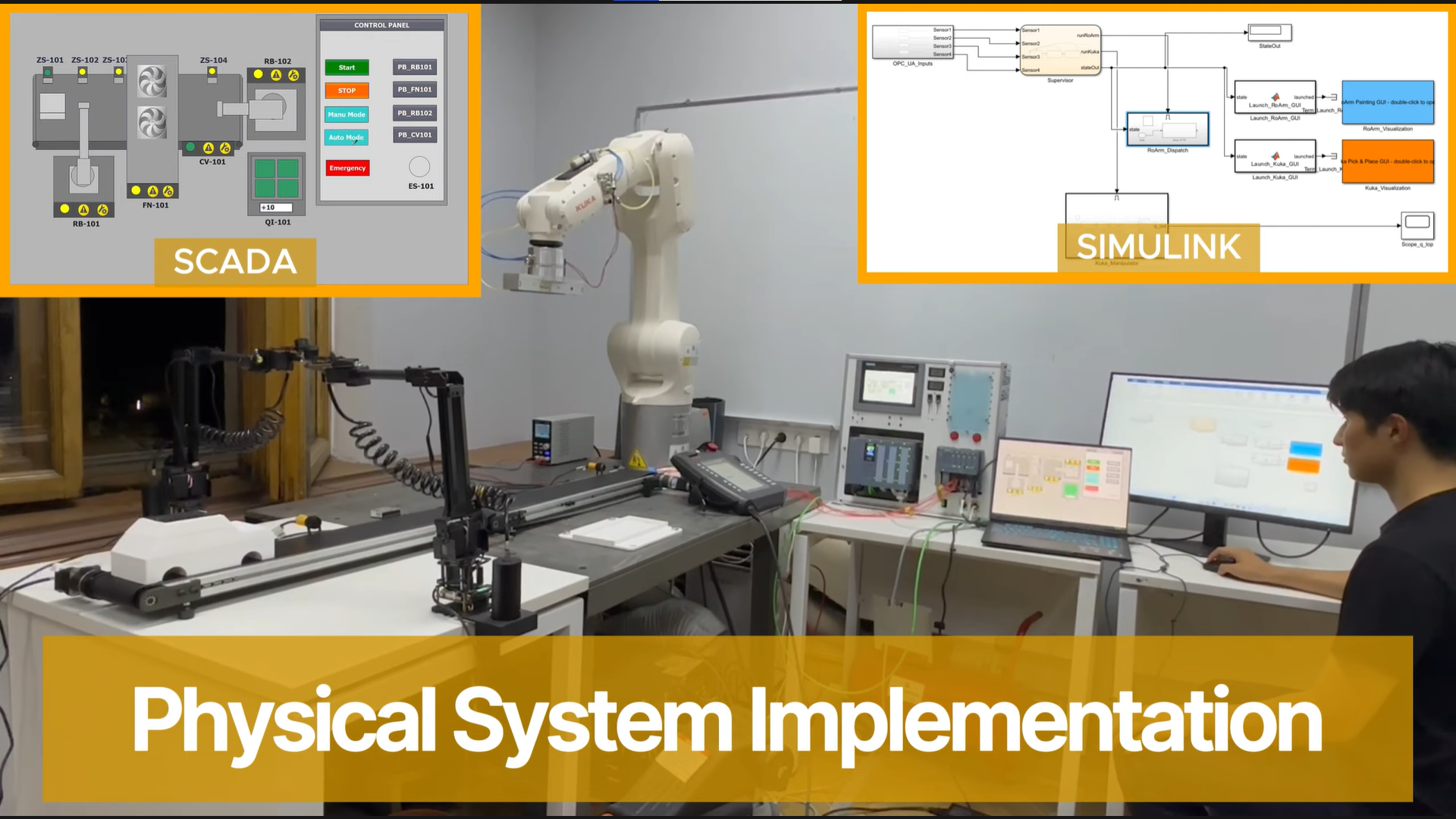
Automated process
The system automates the full part-finishing cycle:
- The conveyor transports and positions the workpiece using inductive proximity sensors.
- Two Waveshare RoArm-M2-S manipulators paint the workpiece simultaneously.
- The conveyor transfers the painted part through the drying station.
- A KUKA KR10 R1100-2 robot unloads the finished part with an electromagnetic gripper.
Every stage transition is controlled by PLC interlocks, keeping the conveyor, painting arms, drying system, and KUKA robot synchronized.
Control architecture
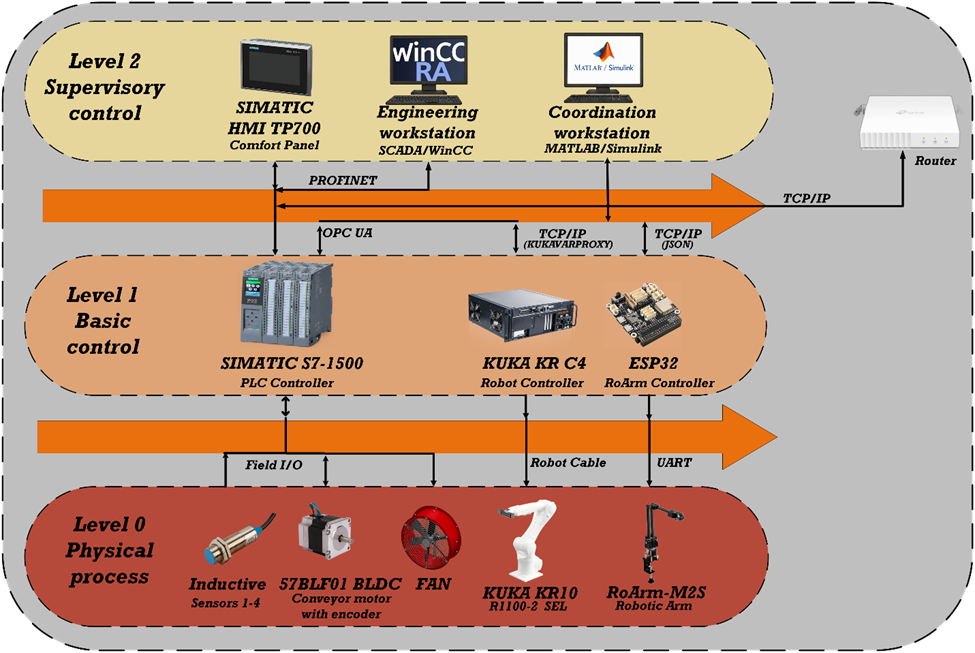
- Supervisory level — MATLAB and Simulink: Performs high-level coordination, trajectory generation, robot dispatch, kinematics, and real-time telemetry. The Simulink supervisor reads workpiece-position sensors through OPC UA and launches the required painting or pick-and-place process.
- Industrial control level — Siemens SIMATIC S7-1500: Executes deterministic sequencing, safety interlocks, field-device I/O, drying control, and closed-loop PID speed control for the BLDC conveyor. A WinCC SCADA/HMI provides operating modes, alarms, trends, and live process visualization.
- Physical level: Includes the KUKA robot, two RoArm manipulators, a BLDC conveyor, four inductive sensors, the drying fan, and the electromagnetic end-effector.
Key engineering work
- Three-robot coordination: Integrated two 4-DOF RoArm painting manipulators with a 6-DOF KUKA industrial robot in one sensor-driven production cycle.
- Multi-protocol communication: Used PROFINET for field devices, OPC UA for PLC–MATLAB supervision, TCP/IP with KukaVarProxy for KUKA control, and HTTP/JSON over Wi-Fi for the RoArm manipulators.
- KUKA pick-and-place control: Developed a MATLAB interface with pose editing, 3D trajectory preview, live joint telemetry, execution controls, and smooth quintic trajectories with joint-limit and singularity safeguards.
- Dual-arm painting control: Implemented MATLAB motion-control classes and a dual-arm application with jogging, workspace preview, path planning, synchronized execution, and telemetry.
- Conveyor regulation: Implemented PLC-based PID speed control for the BLDC conveyor to maintain a constant production takt under changing loads.
- Safety and monitoring: Added PLC-governed operating modes, emergency-stop handling, safety handshakes, device interlocks, HMI alarms, and real-time monitoring of robot and process states.
Technology stack
MATLAB R2025b · Simulink · Siemens TIA Portal V19 · WinCC · SIMATIC S7-1500 · OPC UA · PROFINET · TCP/IP · HTTP/JSON · KUKA KRL · ESP32 · AutoCAD · Fusion 360
Project resources
- Source code and technical documentation (GitHub)
- Full graduation thesis (PDF)
- Project presentation (PDF)